Introduction of the Technology
This technology introduces an environmentally sustainable approach to the thermal treatment of Synthetic Polymer Compounds Waste(SPCW).
It focuses on the production and deployment of appropriate technologies that enable the environmentally friendly
(odor-free, smoke-free, dioxin-free) thermal treatment of SPCW.
Thermal treatment denotes controlled heat-based processes designed to manage end-of-life SPCW
by regulating reaction pathways and mitigating the formation of hazardous byproducts.
While certain regulatory frameworks may categorize such processes under thermal disposal, this work does not represent conventional incineration practices. In this project, synthetic polymer compounds refer exclusively to man-made polymer materials derived from industrial processes, explicitly excluding natural polymers.
The process is designed for non-commercial research purposes and regions where patent restrictions do not apply.
Throughout this document, the term Synthetic Polymer Compound Waste (SPCW) is used as a general term for synthetic polymer-based wastes treated using controlled thermal processing.
Background
SPCW disposal has become a serious environmental issue due to the generation of secondary pollutants during indiscriminate disposal. Furthermore, there are limitations to the environmentally sound disposal of massive amounts of MSW.
Therefore, methods for proper disposal of SPCW locally and environmentally soundly must be explored. However, such technologies need not conflict with public opinion opposing SPCW incineration.
By sharing and implementing technologies and methods, we must accumulate data to gain global recognition and contribute to addressing global environmental issues.
Key Concept
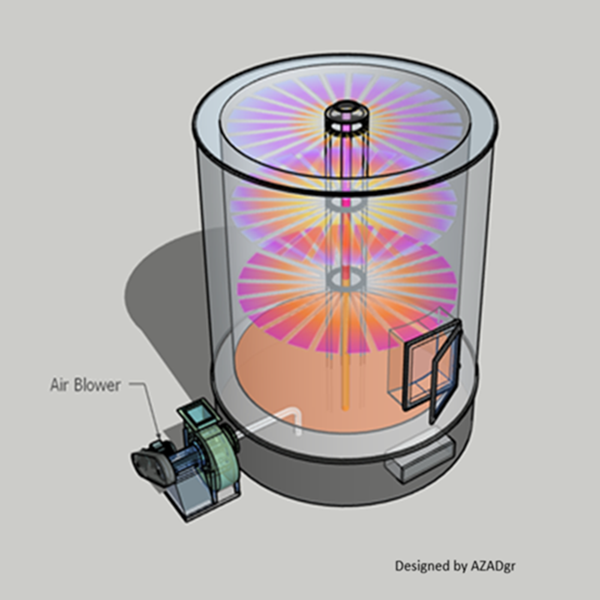
This method utilizes multiple layers of air curtains within the circular chamber to maintain a high internal temperature to prevent the release of dioxins. It also produces no odor or smoke, eliminating the need for additional smoke reduction equipment.
Furthermore, the gases emitted through the top cover alone meet international environmental standards without the need for additional equipment.
Operational limitations & Main Effects
Chambers can be manufactured with internal sizes ranging from as small as 300 mm to as large as 3,000 mm.
For larger capacities, chambers must be connected in series or parallel.
This method prevents smoke or odor from emitting from the ignition stage. Furthermore, by trapping the heat of thermal treatment it maintains high temperatures and prevents the release of harmful gases. Typically, the internal temperature of an chamner is maintained above 850 degrees Celsius during the thermal treatment of SPCW.
Comparison of Dioxin/Furan Emissions (TEQ-based)
This project reports stack-gas dioxin/furan measurements conducted directly at the chamber outlet using SGS standard test methods, without assuming any additional post-treatment devices (e.g. filters, scrubbers, or catalysts). Regulatory limits in the EU and the US are defined in TEQ. While the current dataset is mass-based, the comparison below shows typical TEQ ranges for commercial incinerators for reference.
| Technology type | Typical scale | Typical PCDD/F (ng-TEQ/Nm³) | Remarks |
|---|---|---|---|
| Conventional MSW incinerator (modern) | Large-scale | 0.01 – 0.10 | Designed to meet regulatory limit |
| BAT-level incinerator (advanced) | Large-scale | ~0.01 – 0.05 | Best Available Techniques |
| Small / legacy incinerator | Small-scale | > 0.1 | Often exceeds limits |
| This project | Small / distributed | TEQ pending | Stack gas, SGS method, no post-treatment |
Regulatory reference: EU & US emission limit value: 0.1 ng-TEQ/Nm³
Preliminary stack gas testing indicates ultra-low TEQ levels under controlled thermal oxidation conditions.
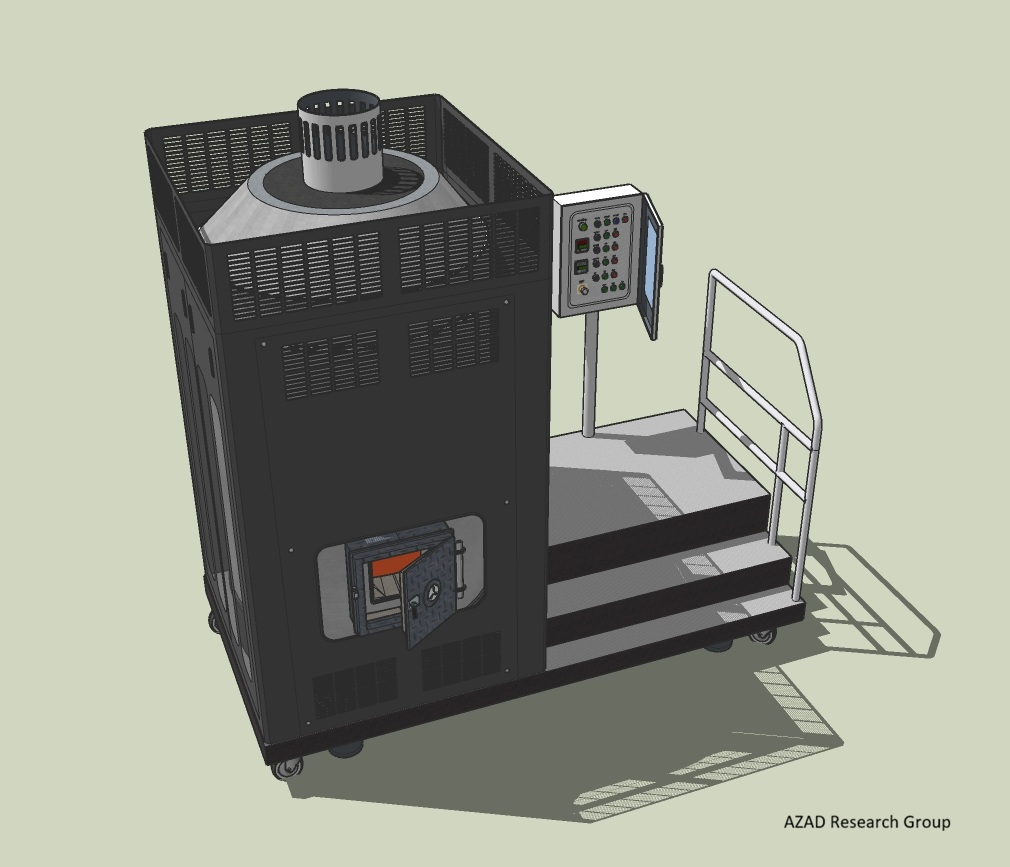
View finished Image
Deliberate Scope: SPCW as the Design Baseline
a. Deliberate Focus on SPCW
Although this system is capable of treating a wide range of wastes, this document intentionally focuses on Synthetic Polymer Compound Waste (SPCW).
This is not a limitation of the technology, but a deliberate framing choice. SPCW represents the most technically demanding class of waste in terms of thermal stability, incomplete oxidation risk, and the formation of hazardous byproducts under conventional thermal treatment.
b. Practical Treatment Scope
In practical operation, the system can continuously treat most waste streams except inert materials such as stone, glass, and bulk metals.
Within this operational boundary, polymer-based materials commonly referred to as “plastics” are treated under controlled thermal conditions, achieving near-complete oxidation even in high-moisture or compositionally mixed streams.
c. Flame-Retardant SPCW Capability
Notably, certain flame-retardant SPCW materials—designed to resist ignition and often problematic for batch-type or plasma-based systems—can be processed reliably using this continuous thermal configuration.
These materials are addressed not through elevated peak temperatures alone, but through sustained oxidation conditions enabled by continuous feed, sufficient air supply, and structural openness of the combustion chamber.
d. Responsible Technology Statement
This approach is presented not as a universal waste solution, but as a responsible technology.
Rather than optimizing for easily combustible materials, the system is designed to address the most environmentally consequential and technically difficult wastes first. If SPCW can be oxidized completely and continuously, other combustible wastes naturally fall within the operational margin.